Carbon Fiber Drive Shafts for Cooling Tower Fans in the Netherlands: The Long-Span Solution
If you have spent any time maintaining fluid and chemical machinery in the industrial heartlands of the Netherlands, you know the nightmare of cooling tower transmission systems. We have seen it a thousand times: you install a heavy steel shaft, and within eighteen months, the humid, saline air from the North Sea—combined with the chemical vapors from the plant—has turned that steel into a rusted, vibrating liability. In our experience, the biggest headache isn’t even the shaft itself; it is that pesky intermediate support bearing required for long steel spans. When that bearing fails (and it always does, usually at 2 AM on a Sunday), it tears up the shaft, and downtime costs skyrocket. This is where the engineering landscape is shifting. Most plant managers don’t realize that simply swapping material from steel to composite can eliminate the intermediate support entirely, solving three problems at once: corrosion, vibration, and maintenance access.
The trick is understanding critical speed. Steel is heavy and flexible over length. To bridge a 4-meter gap between a motor outside the airstream and a gearbox inside the tower, a steel shaft would sag and whip like a jump rope unless you prop it up in the middle. Carbon fiber composite shafts change the physics of this equation completely. Because carbon fiber has an incredible stiffness-to-weight ratio (specific modulus), we can engineer a single-piece shaft that spans 4, 5, or even 6 meters without sagging and without hitting its resonant frequency at operating speeds. This isn’t just about saving weight; it is about removing failure points. For the chemical processing sectors in areas like Botlek or Chemelot, where equipment runs 24/7 and reliability is non-negotiable, moving to a floating shaft design that naturally resists the corrosive cooling tower fog is frankly the only logical upgrade path for modern facility management.
Why Fluid & Chemical Plants Are Switching to Composite Shafts
Let’s get technical for a moment about why we advocate so strongly for composite materials in fluid machinery applications. In traditional setups, the drive train of a cooling tower fan involves a motor, a shaft, and a right-angle gearbox. The environment inside that tower is 100% humidity, often warm, and laden with whatever chemicals are being processed or treated in the water. We call this the “corrosion chamber.” A standard cardan shaft made of steel needs heavy painting, regular greasing, and constant monitoring. Even then, the “fog” inside the tower penetrates seals. We’ve seen maintenance teams struggle with alignment because the steel shaft is so heavy that it is difficult to manhandle into place, leading to poor installation and subsequent vibration issues. Carbon fiber driveshafts, however, are filament-wound tubes. We can control the winding angle to dictate the stiffness and torque capacity precisely.
The real magic happens in the damping characteristics. Fluid and chemical pumps and fans create pulsatile loads—they aren’t perfectly smooth. Carbon fiber has internal material damping properties that steel simply lacks. This means that minor torsional vibrations are absorbed by the material structure itself rather than being transmitted directly into your expensive gearbox bearings. We have seen gearbox life expectancy extend by 30-40% just by switching the transmission element to composite. Furthermore, the specialized “anti-fog” and UV-resistant coatings we apply to the resin matrix ensure that the shaft is virtually impervious to the aggressive chemical atmosphere found in Dutch petrochemical refineries. You install it, you align it (which is easier because it weighs 80% less), and you essentially forget about it for the next decade. That is the kind of reliability engineering we aim for.
Technical Parameters: Cooling Tower Fan Shafts
Below are the typical specifications we engineer for the Dutch market. Note that torque and length are inversely correlated regarding critical speed, so customization is key.
| Parameter | Julat Spesifikasi | Nota |
|---|---|---|
| Bahan Aci | Carbon Fiber Composite / Glass Fiber Hybrid | Filament wound with epoxy resin matrix |
| Flange Material | Keluli Tahan Karat AISI 316L | Marine grade for chemical resistance |
| Continuous Torque | 300 Nm to 4,500 Nm | Custom designs up to 10 kNm available |
| Max Length (No Support) | Up to 6.2 meters | Dependent on operating RPM |
| Suhu Operasi | -40°C hingga +120°C | Suitable for hot vapor extraction |
| Coupling Element | Flexible Disc / Diaphragm (Stainless) | Zero backlash, high misalignment tolerance |
| Salutan | UV Resistant + Anti-Fog Hydrophobic | Prevents water retention and degradation |
| Balance Grade | ISO 1940 G6.3 (Standard) / G2.5 (Option) | Dynamically balanced at speed |
The Dutch Industrial Challenge: Why Material Matters Here
Operating fluid machinery in the Netherlands presents a unique set of variables that many standard equipment manufacturers overlook. We aren’t just talking about rain; we represent a delta region with high groundwater, significant salinity in the air (especially in coastal industrial zones like Maasvlakte), and strict environmental regulations regarding noise and leakage. A standard steel Cardan shaft in a cooling tower in the south of France might last five years; in Rotterdam, you might be lucky to get two years before pitting corrosion compromises the structural integrity. The rust isn’t just cosmetic—it creates an imbalance. An imbalanced long shaft at 1500 RPM is a wrecking ball waiting to happen.
Furthermore, Dutch safety standards (Arbowet) are rigorous regarding maintenance access. Eliminating the intermediate bearing means maintenance personnel do not have to build scaffolding or enter the confined, slippery, and hazardous space of the cooling tower fan deck as frequently. By utilizing our carbon fiber solutions, plant managers in the Netherlands are effectively engineering out the risk. The vibration damping also plays a crucial role in noise reduction, which is increasingly monitored in mixed-zone industrial parks near residential areas. The composite material absorbs the “hum” that hollow steel tubes often amplify, contributing to a quieter overall plant footprint.
Customer Success Case: Retrofit at a Rotterdam Chemical Plant
Cabarannya: A major chemical processing facility in the Botlek area was facing repeated failures on their cooling tower fan drives. The existing setup used a 3-piece steel shaft spanning 4.8 meters with two intermediate bearings. The aggressive chemical vapors and constant humidity caused the bearing seals to fail every 10-14 months, leading to intense vibration that triggered the tower’s vibration switch and shut down the process.
Penyelesaiannya: EVER-POWER engineers conducted a site vibration analysis and proposed a retrofit using a single-piece, filament-wound Carbon Fiber Composite shaft. We engineered the tube diameter to 150mm to ensure the critical speed was well above the operating speed of 1800 RPM. The flanges were machined from AISI 316L stainless steel to resist the chemical attack.
Hasilnya: The new shaft weighed only 18kg (compared to the original 95kg steel assembly). Installation took two technicians just 4 hours. The system has now been running for over 5 years with zero downtime related to the driveshaft. Vibration levels dropped by 65%, significantly extending the life of the gearbox output seals.
EVER-POWER: Custom Engineering & Factory Capability
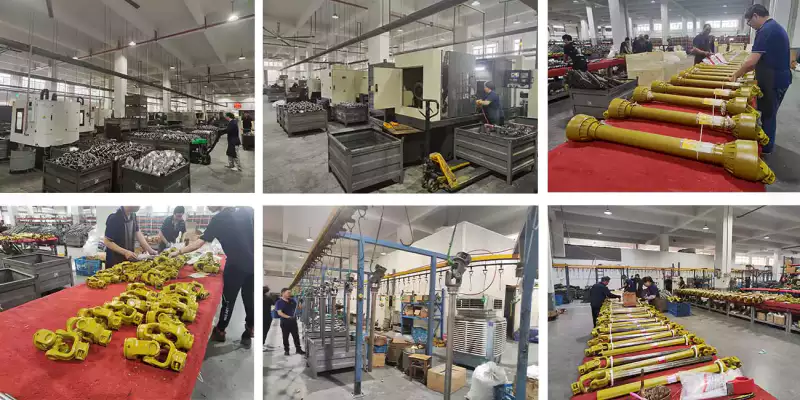
We don’t believe in “one size fits all” when it comes to critical fluid machinery. At EVER-POWER, our factory capabilities are set up for high-mix, custom specification production. We aren’t just cutting tubes to length; we are calculating the laminate architecture of the carbon fiber for your specific torque curve. Do you have a variable frequency drive (VFD) that passes through a specific resonance frequency during startup? We can tune the shaft’s stiffness to ensure you don’t linger in that danger zone. Our workshop is equipped with dynamic balancing machines capable of handling shafts up to 8 meters long, ensuring that what you receive is ready to spin smoothly right out of the crate.
We stock various composite tube diameters and high-grade stainless steel flange billets, allowing us to react quickly to breakdown situations. While a standard order might take a few weeks for engineering and production, we have turned around emergency replacements for critical infrastructure in days. Our integration of flexible elements—specifically stainless steel disc packs—ensures that even if your cooling tower structure shifts slightly over seasons due to thermal expansion, the drive train remains compliant and stress-free.
Common Questions About Upgrading to Composite Cooling Tower Shafts
Is a carbon fiber driveshaft really worth the extra cost for a standard HVAC cooling tower in Amsterdam?
Absolutely, and here is why: while the upfront purchase price might be higher than steel, the total cost of ownership is lower. Think about the crane rental cost to lift a heavy steel shaft, the downtime during bearing lubrication, and the inevitable replacement costs. Most facilities in Amsterdam break even on the investment within 24 months purely on reduced maintenance labor.
How do I know if the composite shaft can handle the startup torque of my large fluid chemical pump system?
We engineer the laminate specifically for this. The carbon fibers are wound at specific angles to maximize torsional strength. Our shafts typically handle 3 to 4 times the nominal torque as a safety factor, meaning they easily absorb the “kick” of a direct-on-line motor start without delaminating or twisting.
Where can I find a supplier that customizes the flange connection to fit my old Marley or BAC cooling tower gearbox?
Right here. You don’t need to buy a standard off-the-shelf part that requires you to machine adapter plates. We machine the stainless steel flexible coupling flanges to match your exact bolt pattern, pilot diameter, and hub length. It’s a plug-and-play solution designed for your specific equipment model.
What happens if the cooling tower shaft gets hit by falling ice or debris during a Dutch winter storm?
Composite shafts are incredibly resilient to fatigue, but impact damage can be a concern. However, unlike steel which might bend and then destroy your gearbox due to imbalance, carbon fiber tends to shred or “broom” upon catastrophic failure, which actually protects the expensive gearbox and motor from shock loads. We also apply protective coatings to resist minor impacts.
Can you ship these long 6-meter drive shafts directly to my facility in the Groningen industrial zone?
Yes, logistics for long items is part of our service. Because they are lightweight, they are easier to transport than steel, but the length requires special handling. We crate them securely to prevent damage and can deliver directly to the site anywhere in the Netherlands, ready for your maintenance team to install.
Ready to Eliminate Cooling Tower Downtime?
Stop battling rust and vibration. Upgrade to EVER-POWER composite technology today.