Relentless Torque: Drive Shafts for Dutch Cement Conveyor Systems
If you manage a bulk handling terminal in the Maasvlakte or a concrete batching plant in North Brabant, you know the sound of a conveyor struggling against a cold morning start. It’s that low-frequency groan before the belt fully tightens. In that split second, the drive shaft connecting your motor to the head pulley gearbox is taking a beating that most standard catalogs don’t account for. I’ve spent 18 years diagnosing driveline failures, and in the cement industry, the culprit is rarely just “torque”—it’s the combination of fluctuating loads et abrasive dust.
Cement conveyors are the arteries of the industry. Whether you are moving clinker, fly ash, or raw limestone, the material flow isn’t liquid; it surges. A blockage in the chute or a sudden dump from a grab crane sends a shockwave back through the driveline. If your Cardan shaft (universal joint shaft) isn’t engineered with the correct Service Factor (K), the weakest link—usually the spline or the cross bearing—will fail. And in the Netherlands, where uptime is dictated by tight shipping schedules and strict environmental permits, a broken shaft isn’t just a repair cost; it’s a logistical nightmare.
Engineer’s Log: The “Invisible” Grinding Paste
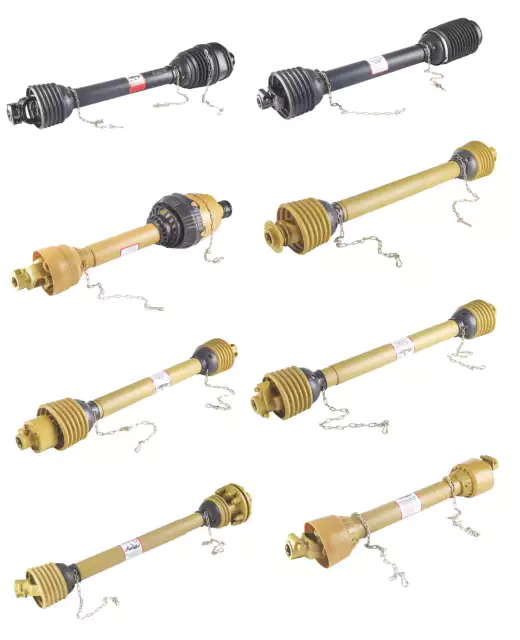
“I recall a site visit to a transshipment terminal near Rotterdam back in 2021. They were burning through drive shaft splines every six months on their main ship unloader conveyor. The maintenance team was diligent—greasing them every week. But that was actually the problem. The standard rubber seals were letting in microscopic clinker dust. By pumping in fresh grease, they were essentially mixing a high-grade grinding paste inside the slip yoke. We swapped them to our ‘EP-Cement Spec’ shaft with Rilsan-coated splines and a metal-shielded boot. They haven’t replaced a shaft since.”
The Dutch Industrial Context: Wet, Windy, and Dusty
Operating in the Netherlands presents a unique metallurgical challenge: Corrosion-Fatigue. The air in our coastal industrial zones (like Botlek or Europoort) is salty and damp. When you mix moisture with cement dust, you get a corrosive crust that hardens on the telescoping section of the drive shaft. If the shaft can’t expand and contract freely due to this crust, the axial load is transferred directly to your gearbox bearings. We have seen perfectly good gearboxes destroyed because a €500 drive shaft seized up.
To combat this, our shafts for the Dutch market feature a Long-Travel Spline Compensation design. We use extended slip lengths to accommodate the significant thermal expansion and structural flexing of long overland conveyor gantries. Furthermore, our proprietary “Anti-Dust” coating on the tube section prevents the cement buildup from adhering to the metal, keeping the dynamic balance true even after months of operation.
Inquire Now – Protect Your Conveyor
Technical Specifications: EP-Conveyor Series (Cement Spec)
We don’t sell “off-the-shelf” automotive shafts for industrial work. Below are the specific parameters for our heavy-duty series, randomized within the 200-500 kNm range to reflect the robust requirements of Dutch cement logistics.
| ID du paramètre | Description des spécifications | Valeur / Plage | Unité |
|---|---|---|---|
| CV-01 | Couple nominal (Tn) | 220,000 – 480,000 | Nm |
| CV-02 | Fatigue Torque Limit (Tdw) | 310,000 | Nm |
| CV-03 | Facteur de service (K) | 2.0 – 3.5 | – |
| CV-04 | Flange Diameter (D) | 350 / 390 / 435 | mm |
| CV-05 | Closed Length (L_min) | 1350 – 2600 | mm |
| CV-06 | Compensation de longueur | 250 – 450 | mm |
| CV-07 | Operational Angle | 5 – 10 (Dynamic) | Diplômes |
| CV-08 | Angle d'articulation maximal | 15 | Diplômes |
| CV-09 | vitesse de rotation | 300 – 600 | tr/min |
| CV-10 | Diamètre du tube | 219 – 273 | mm |
| CV-11 | Épaisseur de paroi | 12.5 – 18.0 | mm |
| CV-12 | Type de spline | Involute DIN 5480 | – |
| CV-13 | Matériaux (jougs) | 42CrMo4 forgé | Acier |
| CV-14 | Material (Cross Kit) | 20CrMnTiH | cémentation |
| CV-15 | Dureté de surface | 48 – 54 | HRC |
| CV-16 | Core Hardness | 28 – 34 | HRC |
| CV-17 | Niveau d'équilibrage | G 16 (ISO 1940) | – |
| CV-18 | Durée de vie du roulement (L10h) | > 35,000 | Heures |
| CV-19 | Rigidité en torsion | 4.25 x 10^5 | Nm/rad |
| CV-20 | Système d'étanchéité | Multi-lip + Metal Shield | étanche à la poussière |
| CV-21 | Spécifications du revêtement | Epoxy Powder (Dust Resistant) | RAL 7035 |
| CV-22 | Raccord à bride | Clé faciale / Serration de Hirth | Facultatif |
| CV-23 | Bolt Grade Required | 10,9 ou 12,9 | Métrique |
| CV-24 | Intervalle de lubrification | 1000 (with EP-2) | Heures |
| CV-25 | Poids (approximatif) | 450 – 850 | kg |
| CV-26 | Axial Force (Telescoping) | < 3200 | N |
| CV-27 | Vitesse critique | > 1200 | tr/min |
| CV-28 | Tube Runout | < 0.8 | mm/m |
Customization: The Art of Retrofitting
Many cement plants in the Benelux region are operating on legacy infrastructure. You might have a conveyor system built by Krupp or Koch in the 1980s. The original drive shafts are likely obsolete, or the OEM lead time is 20 weeks. We understand that you cannot pause a ship unloading operation for five months.
Nous sommes spécialisés dans Ingénierie inverse. If you provide us with the flange dimensions (Bolt Circle, Pilot Diameter) and the compressed length, we can manufacture a modern, drop-in replacement. We don’t just copy the old design; we upgrade it. We use 42CrMo4 Quenched and Tempered Steel for the yokes, which offers superior fatigue resistance compared to the older C45 steels used decades ago. We can also add “Face Keys” to the flange connection to handle higher torque density, effectively locking the shaft to the gearbox hub.
Obtenez un devis de rénovation
Success Story: The Bulk Terminal in Vlissingen
Le défi : A major bulk terminal in Vlissingen was experiencing severe vibration on its stacker-reclaimer boom conveyor. The varying angle of the boom (luffing) was causing the existing drive shaft to operate at angles exceeding 12 degrees, creating a non-uniform velocity whip.
Notre solution : We replaced the standard shaft with a Wide-Angle Double Cardan Shaft. This design cancels out the velocity fluctuation internally, ensuring smooth rotation even at steep angles. We also applied a marine-grade paint system to withstand the salt spray.
Le résultat : Vibration levels at the gearbox input bearing dropped by 85%. The lifespan of the gearbox seals extended from 8 months to over 3 years. The client has since standardized this shaft design across all their luffing conveyors.
Compatibilité des marques et mentions légales
In the heavy industry sector, you will see names like GKN, Voith, Elbe, ou Dana/Spicer on your equipment lists. These are respected giants in the industry, and we acknowledge their engineering pedigree.
However, being an independent manufacturer allows us to be agile. When you need a custom-length shaft in 3 weeks because a ship is docking, we can move faster than the big conglomerates. We build to the same DIN and ISO standards, but with a service model built for urgent industrial needs.
Connecting the Field: Gearboxes for Dutch
It’s a short drive from the industrial ports of Rotterdam to the fertile polders of South Holland, and the engineering needs transition seamlessly. The same physics that govern a cement conveyor—torque, sealing, and durability—apply to the agricultural machinery that feeds the world. Ever-Power is not just an industrial specialist; we are a leading supplier of Boîtes de vitesses agricoles tailored for the intensive farming practices of the Netherlands.
In Dutch agriculture, efficiency is everything. Whether it’s a high-capacity fertilizer spreader working a tulip field or a heavy-duty power harrow preparing clay soil for potatoes, the gearbox is the heart of the implement. We manufacture gearboxes that are designed to survive the “mud and blood” of the harvest season.
Pourquoi nos boîtes de vitesses ?
Our gearboxes are engineered to pair perfectly with our PTO shafts, creating a unified driveline solution. We offer:
- Robust Cast Iron Housings: Designed to withstand the shock loads of hitting stones or compacted soil. Unlike lightweight aluminum housings, ours don’t flex under load.
- Engrenages coniques de précision : We use spiral bevel gears that are carburized and ground. This ensures quiet operation and high efficiency (up to 98%), transferring more power from the tractor PTO to the working tool.
- Advanced Sealing: Just like our cement shafts, our ag gearboxes use dual-lip seals to keep oil in and contaminants out. This is critical for machines that are pressure-washed daily.
We supply a wide range of configurations, including T-Boxes for mowers, L-Boxes for spreaders, and Speed Increasers for hydraulic pumps. If you are an OEM building machinery in the Netherlands, or a dealer looking for reliable aftermarket replacements for brands like Comer or Bondioli & Pavesi (see disclaimer above), our “Power Package” of matched gearbox and shaft offers unbeatable value and reliability.
Foire aux questions (FAQ)
How often should I grease a drive shaft in a cement plant?
In a dust-heavy environment, “more” isn’t always better. Over-greasing can blow out seals. We recommend greasing every 1,000 hours with a high-quality Lithium Complex EP-2 grease, but crucially, you must wipe the fittings clean avant attaching the gun to prevent injecting dust.
Can you deliver to industrial zones like Chemelot or Moerdijk?
Yes. We have established logistics routes to all major Dutch industrial hubs. We are familiar with the site safety requirements and gate procedures for delivering heavy freight into petrochemical and cement zones.
What causes drive shaft vibration on long conveyors?
It’s often a combination of misalignment and imbalance. If the conveyor structure has settled (common in soft Dutch soil), the operating angles of the U-joints may no longer be equal. This creates a non-uniform velocity “whip.” We can assist with on-site alignment checks.
Do you offer face key connections for high-torque drives?
Absolutely. For torque loads exceeding 200 kNm, friction grip from bolts alone is risky. We machine precision “Face Keys” across the flange face to positively lock the shaft to the gearbox hub, ensuring that the shear load is taken by the key, not the bolts.
Mise à jour du secteur (Pays-Bas 2026) : The Dutch “Betonakkoord” (Concrete Agreement) is driving a shift towards using more recycled aggregates in cement production. This material is often more abrasive and variable in density than virgin limestone, leading to higher shock loads on conveyor drivelines. Plant operators should review their Service Factors to ensure they are prepared for this heavier-duty cycle.