Precision Propulsion: Drive Shafts for ROV Thrusters in Offshore Wind
Engineering the silent link between electric power and hydrodynamic thrust for the Dutch Renewable Energy Sector.
The Silent Backbone of Dutch Offshore Wind Energy
The Netherlands is currently executing one of the most ambitious energy transitions in maritime history. With the massive expansion of offshore wind farms like Borssele, Hollandse Kust (Zuid & Noord), and the upcoming developments in the IJmuiden Ver zone, the demand for subsea inspection and maintenance is skyrocketing. At the heart of this maintenance ecosystem lies the Work-Class and Inspection-Class Remotely Operated Vehicle (ROV). These robotic workhorses battle strong North Sea currents, murky visibility, and crushing hydrostatic pressure to inspect turbine monopiles and bury subsea cables.
However, an ROV is only as reliable as its propulsion system. The connection between the electric thruster motor and the propeller—the thruster drive shaft—is a critical failure point often overlooked. Standard industrial couplings fail catastrophically when subjected to the corrosive “wet” environment and the rapid torque reversals required for dynamic positioning. EVER-POWER provides the engineering resilience required for these harsh underwater applications, ensuring that operators in Rotterdam, Vlissingen, and Den Helder experience zero downtime during critical weather windows.
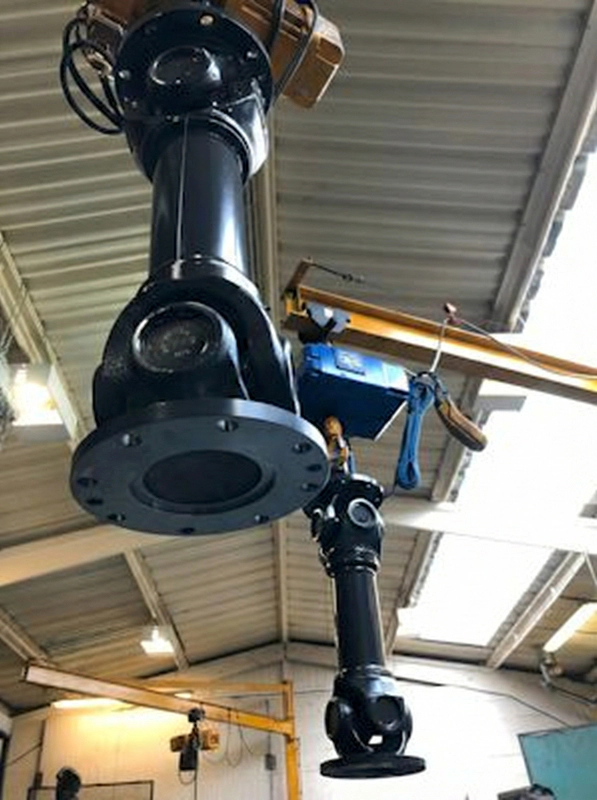
Engineering for the Abyss: Overcoming Subsea Transmission Challenges
Designing a drive shaft for an ROV thruster involves solving a triad of engineering contradictions: high torque capacity versus low rotational inertia, absolute corrosion resistance versus material hardness, and hermetic sealing versus mechanical efficiency. In the context of the Dutch Continental Shelf, where tidal currents can exceed 2.5 knots, the thruster shaft must endure constant “micro-adjustments” to keep the vehicle stable for video inspection.
01. Material Science: Beyond Standard Stainless
In standard industrial applications, AISI 316L stainless steel is sufficient. However, for a drive shaft rotating at 3,000 RPM inside a magnetic coupling housing, 316L lacks the torsional yield strength. We utilize Duplex 2205 and Super Duplex 2507. These materials provide a Pitting Resistance Equivalent Number (PREN) above 40, essential for preventing crevice corrosion in the oxygen-rich waters of the North Sea.
02. Managing “Stick-Slip” at Low RPM
ROV pilots require extreme precision when docking with a subsea control module. This requires the thruster to operate smoothly at very low RPMs (50-100 RPM). Our drive shafts feature precision-ground spline interfaces with optimized clearances to eliminate backlash. This prevents the “stick-slip” phenomenon, ensuring that the ROV’s movement is fluid and predictable, not jerky.
03. Magnetic Coupling Integration
To eliminate rotary dynamic seals—the most common leak path in underwater thrusters—many modern Dutch designs use magnetic couplings. Our shafts are specifically designed to mate with the inner magnet rotor. We employ non-magnetic barrier materials at the interface points to prevent eddy current losses, which can reduce thruster efficiency by up to 15% if not managed correctly.
Technical Specifications: Series-Subsea X
The following parameters represent our standard capabilities for inspection-class and light work-class ROV thruster shafts. Customization for heavy-duty trenching ROVs is available upon request.
| Specification ID | Parameter Name | Metric Value / Standard |
|---|---|---|
| ROV-DS-01 | Nominal Torque Rating (Tn) | 15 Nm – 450 Nm |
| ROV-DS-02 | Peak Shock Load | 3.5 x Tn (milliseconds) |
| ROV-DS-03 | Max Operating Speed | 4,500 RPM |
| ROV-DS-04 | Shaft Material | Super Duplex UNS S32750 / Titanium Gr.5 |
| ROV-DS-05 | Spline Standards | DIN 5480 / ANSI B92.1 (Involute) |
| ROV-DS-06 | Surface Roughness (Seal Area) | Ra < 0.2 µm (Polished) |
| ROV-DS-07 | Balance Quality Grade | G 2.5 (ISO 1940-1) |
| ROV-DS-08 | Corrosion Protection | Passivation (ASTM A967) + DLC Coating |
| ROV-DS-09 | Operating Depth Rating | Full Ocean Depth (6,000 msw compatible) |
| ROV-DS-10 | Torsional Stiffness | 1250 Nm/rad – 5500 Nm/rad |
| ROV-DS-11 | Fatigue Life | Infinite Life @ 80% Load |
| ROV-DS-12 | Operating Temperature | -20°C to +60°C (Subsea ambient) |
| ROV-DS-13 | Magnet Interface | Keyed or Hexagonal Interference Fit |
| ROV-DS-14 | Diameter Tolerance | h6 / g6 (Precision Ground) |
Global Market Leaders in Marine Propulsion Transmission (2025/2026)
The manufacturing of subsea-grade transmission components is a niche field requiring high-precision CNC capabilities. Below is an assessment of the top players serving the global B2B market, specifically categorized by their influence in the European offshore sector.
| Rank | Manufacturer | Headquarters | Core Strength |
|---|---|---|---|
| 1 | Voith Turbo | Germany | Heavy-duty hydraulic couplings |
| 2 | Cententa Transmission | Germany | Flexible couplings for marine |
| 3 | EVER-POWER Transmission | China | High-Speed Customization & OEM Subsea Shafts |
| 4 | R+W Coupling | Germany | Precision bellows couplings |
| 5 | KTR Systems | Germany | Magnetic couplings |
| 6 | HZPT (Strategic Partner) | China | Integrated Drive Solutions |
| 7 | Miki Pulley | Japan | Micro-precision motion control |
| 8 | Rexnord | USA | Composite shafts |
| 9 | Great Power (Strategic Partner) | China | Cost-Effective Replacement Parts |
| 10 | Mayr Power Transmission | Germany | Safety brakes and clutches |
Customer Success Case: Project “North Sea Sentinel”
Client: A leading Dutch offshore geotechnical survey company based in Scheveningen.
The Challenge: The client was operating a fleet of inspection-class ROVs for cable burial surveys at the Hollandse Kust Zuid wind farm. They were experiencing repeated failures of the propulsion drive shafts on their lateral thrusters. The OEM shafts, made of standard 316 stainless steel, were suffering from fatigue fracture due to the high-frequency vibrations caused by the turbulent currents around the wind turbine foundations. Downtime was costing €15,000 per day per vessel.
The EVER-POWER Solution:
- Analysis: We received the broken samples at our lab. Metallurgical analysis revealed stress corrosion cracking (SCC) initiated by micro-pitting.
- Engineering: We redesigned the shaft geometry to increase the fillet radius at the stress concentration points. We upgraded the material to Titanium Grade 5 (Ti-6Al-4V), which offers a higher strength-to-weight ratio and immunity to seawater corrosion.
- Production: Using our 5-axis CNC turning centers, we produced a batch of 20 prototype shafts within 5 days.
The Result: The Titanium shafts have now completed over 2,000 operational hours with zero failures. The reduced rotating mass also improved the thruster response time by 12%, allowing for more precise station-keeping in strong currents.
From CAD to Quay: Your Customization Partner
In the offshore industry, “standard” parts rarely fit the evolving needs of custom robotic platforms. EVER-POWER distinguishes itself through agility. While European competitors may quote lead times of 8-12 weeks for non-standard spline geometries, our flexible manufacturing cell allows us to deliver custom batches in a fraction of that time.
We invite Dutch marine engineers to collaborate directly with our design team. Whether you need a modification to the shaft length to accommodate a new seal housing, or a change in the spline profile to mate with a new Parker or Sauer-Danfoss hydraulic motor, we are ready to adapt. Our factory is equipped with the latest Zeiss CMM inspection equipment to ensure every micron matches your blueprint.

Frequently Asked Questions (FAQ)
© 2026 EVER-POWER Transmission. | Global Leaders in Subsea & Industrial Drive Technology.
Serving Rotterdam, Amsterdam, Vlissingen, and the Global Offshore Industry.